
Two guards and two doors
One door is safe and one is not. One guard always lies and one always tells the truth. You may ask one guard one question. What do you ask to choose the safe door?
Start this challengeIncludes one hint
problem.so gives you one explained reasoning challenge each day, plus tools and guides that help you apply the method behind the answer.
Read carefully. The useful clue may not be the most obvious one.
One door is safe and one is not. One guard always lies and one always tells the truth. You may ask one guard one question. What do you ask to choose the safe door?
Choose the task, not the tool name. The recommendation explains what to prepare and opens the correct workspace.
Turn a vague concern into a measurable gap, evidence plan, constraint list, and smallest useful experiment.
Prepare: one observable problem, who or what is affected, and the evidence currently available.
Problem framing worksheet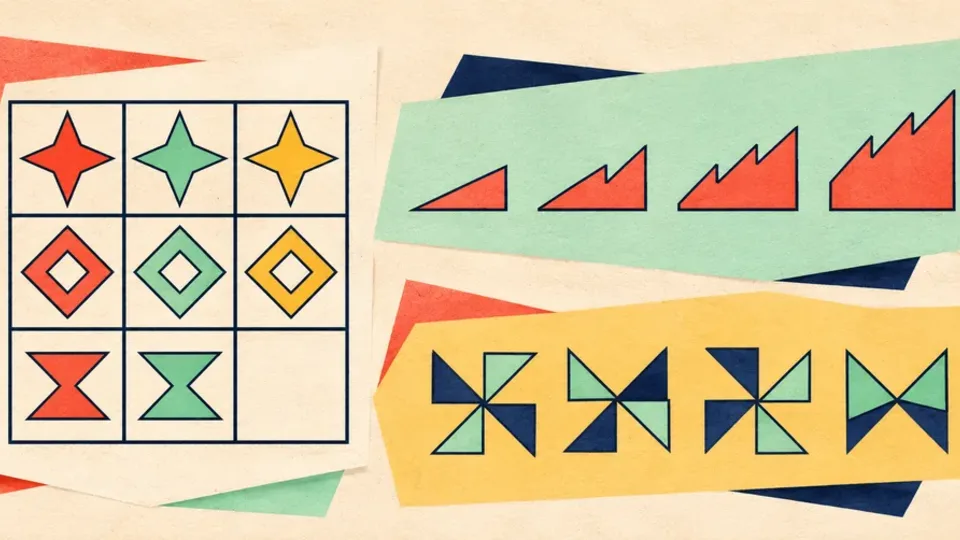
Try the free visual puzzle games built from shapes, position, color, and repetition. Each game responds immediately and explains the rule in one clear sentence.
The prompt comes first. The hint, worked reasoning, and verification stay under your control.
Write your model and the evidence behind each important step. A timer is available, but speed is optional and is not treated as intelligence.
Reveal the hint after a stopping rule, such as five minutes without a new deduction. Record which assumption or representation it changed.
Check the answer against every condition, compare the first weak step, and try the variation to see whether the corrected method transfers.
The goal is not a leaderboard position. It is a reasoning trail you can inspect and reuse. The Problem of the Day includes a private seven-day practice log stored only in your browser.
Each format trains a different part of problem solving.
Practice deductions, constraints, patterns, and optimization with explained answers.
Generate a puzzleMeasure how you handle inference, probability, verbal logic, and sequences.
Take the testTurn a vague issue into a measured gap, evidence plan, and next experiment.
Frame a problemBoth require clear reasoning, but they differ in what counts as a useful result.
The rules and clues define a search space. A strong solution finds a valid answer, shows why alternatives fail, and checks whether the answer is unique.
Start with the logic puzzles and deductive reasoning path or choose an explained challenge.
The evidence is incomplete and the goal may be disputed. A useful result defines the measurable gap, keeps competing explanations alive, and chooses a safe next test.
Use the real-world problem-solving path or build a brief with the problem framing worksheet.
Our problem-solving guides and puzzle methods turn puzzle techniques into processes you can reuse for schedules, decisions, investigations, and everyday constraints. Use the problem-solving glossary when a logic or decision term needs a precise definition. The problem-solving articles library publishes additional reviewed explanations and challenges.
Explore all guidesTranslate every clue into a constraint, record what is impossible, and make only the deductions the evidence supports.
Lateral thinking is disciplined reframing. Generate alternatives first, then test them against the facts.
A root cause is a changeable mechanism supported by evidence, not merely the last mistake in a timeline.
A fair puzzle hides the path, not the rules. Solvers should be able to explain why the answer follows.
Start with the kind of problem in front of you.
Logic problems become manageable when their rules are moved out of working memory and into a visible model. This collection focuses on representation, deduction, search, and verification.
Explore logic puzzles and deductive reasoningLateral thinking is not a license for arbitrary answers. It is a method for finding hidden assumptions and producing alternatives that can be tested against the stated facts.
Explore lateral thinking challengesReal problems contain uncertainty, incomplete data, and competing goals. These guides show how to define the gap, model constraints, collect discriminating evidence, and evaluate interventions.
Explore real-world problem solvingPuzzle construction is a form of information design. A strong puzzle controls ambiguity, rewards the intended reasoning, and proves that its answer is unique.
Explore puzzle design and constructionChoose from logic puzzles and brain teasers with answers, including lateral-thinking challenges, optimization problems, and real-world cases. Every challenge includes a hint, an explained answer, and a reusable lesson. For a shorter mixed set, start with the free four-problem puzzle sampler.
Read about problem.so and its publishing standards, see how each problem is designed and checked, and review the editorial and puzzle quality policy.
This useful-page selection changes every day. Across one short cycle, it features every guide, challenge, tool, topic, article, and site information page.
A necessary condition must be present. A sufficient condition is enough to guarantee the stated result.
Most wrong solutions come from representation errors, not a lack of cleverness.
Measure exactly 45 minutes with two uneven-burning ropes and learn why completion events work even when burn rates are unreliable.
Draw a rotating 12-question set from 100 visual problems, then review four answers before opening the remaining explanations.
Learn puzzle design through clue construction, solution checks, playtesting, ambiguity control, and evidence-based difficulty calibration.
Try a mixed four-problem sampler and review the scope of the themed collections now in development.
Browse reviewed articles, new challenges, worked examples, and practical methods as they are published.
Report a counterexample, factual error, broken tool, accessibility problem, or privacy request with useful evidence.
Inclusive OR allows either or both. Exclusive OR allows exactly one and rules out the both case.
Today’s challenge is waiting. Take your time, reveal one hint if you need it, and compare the reasoning after you commit to an answer.