
Which tile completes the pattern?
This question practices matrix reasoning.
Question 1 of 12
Answered0
Solve a rotating 12-question set drawn from 100 original matrix, sequence, classification, and spatial questions. Answers remain hidden until your results.
Start the practice test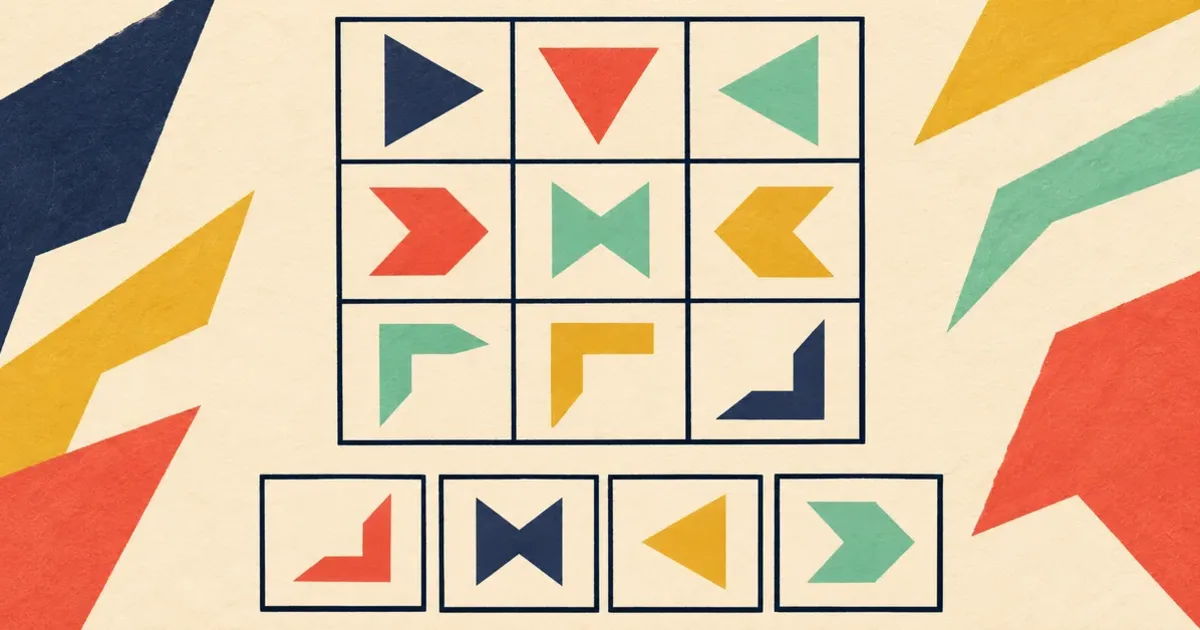
It checks whether you can detect rules across matrices, sequences, classifications, and spatial changes. Each visit draws a different set from 100 questions. The result is a practice score and category breakdown, not an IQ estimate.
This question practices matrix reasoning.
Start with the simplest visible features: shape, color, count, and orientation. Test one possible rule across every tile before combining two rules. If a rule explains only the final pair, it is probably incomplete.
This practice set is untimed because rushed guesses reveal little about the source of an error. Explain the rule before choosing an answer. Correctness stays hidden during the test, so the next choice cannot be influenced by immediate feedback.
The total counts correct answers only in the rotating set you received. Results begin with four answer explanations and let you open the remaining eight when ready. The category breakdown can point you toward more visual puzzle game practice or the step-by-step logic puzzle method. It cannot establish an IQ percentile or diagnosis.
No. This independent practice set was created by problem.so. It is not affiliated with, endorsed by, or scored by Mensa. An official supervised assessment follows different controls and norms.
It is the number of correct answers in a rotating 12-question set drawn from 100 visual questions. Use the skill breakdown to choose what to practice. Do not convert it into an IQ number or percentile.
Correct answers are withheld during the test. The result first presents four reviewed answers, then lets you open the remaining eight explanations.
Yes. The test runs in your browser. Your selected answers are not submitted to problem.so. Local browser storage only remembers recent question IDs to reduce repetition.